

Your data already lives in Google Sheets. Prices, schedules, team lists, product specs: you update them there every week. Now you want the same data on your WordPress site as a clean, readable table.
The tricky part is choosing how. Some methods keep the table in sync with your sheet automatically. Others give you a better looking table but need a quick manual update when the data changes.
This guide walks you through four ways to display a Google Sheet as a table in WordPress, with clear steps for each, so you can pick the one that fits your data.
Quick answer
- Need a live table that updates when the sheet changes? Use a sync plugin such as FlexTable, or embed the sheet with Google’s “Publish to web” option.
- Want a fully styled, fast, SEO-friendly table? Copy the cells from Google Sheets, paste them into the block editor, and convert the result into a Tableberg table.
- Already use TablePress? Import the sheet from its published CSV link.
Which Method Should You Use?
Here is how the four methods compare at a glance. The main question is simple: does your table need to update on its own, or do you care more about how it looks?
|
Método |
Stays in sync? |
Design control |
Custo |
Best for |
|---|---|---|---|---|
|
Tableberg (copy and paste) |
No, you update it by hand |
Full: colors, buttons, images, mobile stacking |
Free (Pro adds sort, search, pagination) |
Styled pricing, comparison, and spec tables |
|
FlexTable plugin |
Yes, from the connected sheet |
Medium: themes and table options |
Free (Pro is a paid upgrade) |
Data you edit often in Google Sheets |
|
Publish to web Incorporar |
Yes, within a few minutes |
Low: looks like Google Sheets |
Free, no plugin |
Quick reference views |
|
TablePress import |
Only with TablePress Max |
Medium, mostly with CSS |
Free import (auto sync is paid) |
Sites already using TablePress |
This comparison table is built with Tableberg, a free table block for the WordPress block editor.
Before You Start: Prepare Your Google Sheet
A few minutes of cleanup in the sheet saves you a lot of fixing later, whichever method you choose.
- Use one header row. Put clear column names in row 1, such as Plan, Price, and Storage.
- Remove empty rows and columns between your data. They show up as blank lines in the table.
- Keep one table per tab. Sync plugins and embeds read a whole tab or range, so extra notes on the side will appear too.
- Check what is private. Live methods need a sheet that anyone with the link can view, so never sync a tab that holds personal or sensitive data.
For the live methods (FlexTable and Publish to web), open your sheet and click the Share button in the top right corner.
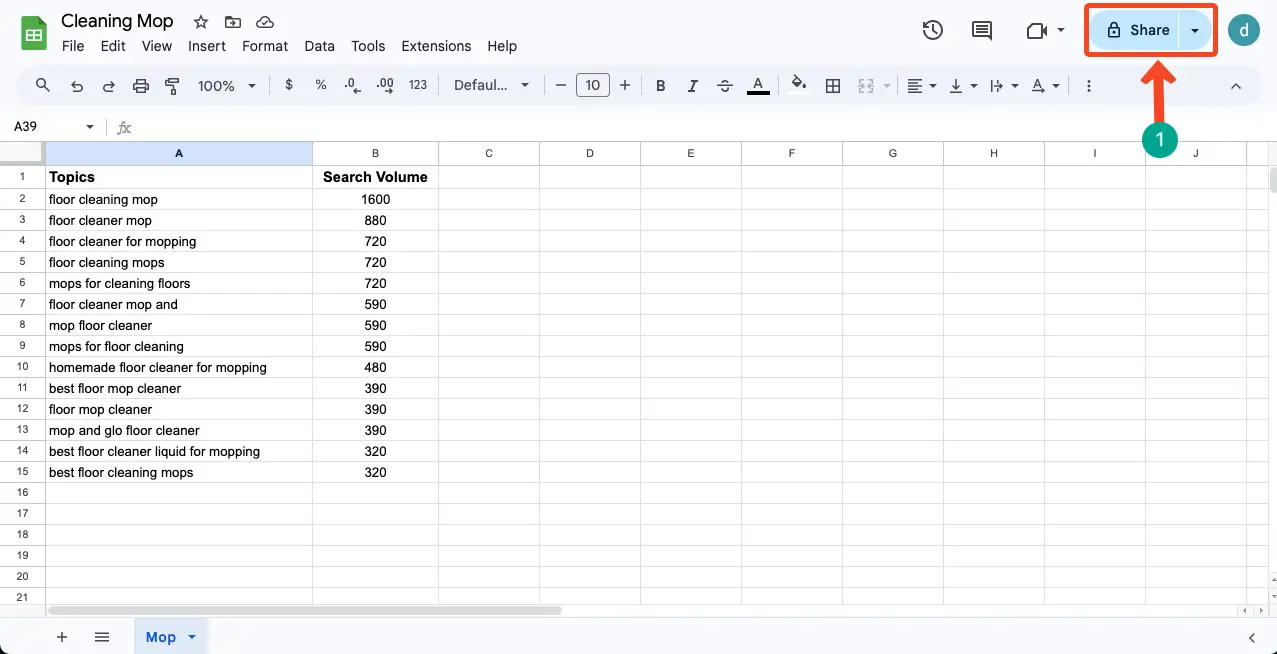
Under Acesso geral, choose Quem tiver o link and keep the role as Viewer. Then click Copy link.

Method 1: Copy Your Sheet Into Tableberg (Best Looking Table)
Ideal para: pricing tables, comparison tables, specs, and any data that changes now and then rather than every hour.
Tableberg is a free table block plugin for the WordPress block editor with more than 4,000 active installs and a 4.8 out of 5 rating on WordPress.org (November 2026). Because the table lives inside your post as real HTML, search engines and AI assistants can read every cell, and you can add buttons, images, and lists inside cells.
This method does not sync. When your sheet changes, you edit the table in WordPress or paste the new data again.
Etapa 1: Instalar o Tableberg
In your dashboard, go to Plug-ins > Adicionar novo plug-in, procure por Tableberge, em seguida, clique em Instalar agora e Ativar. O first table guide covers the basics if you are new to it.
Step 2: Copy the Cells From Google Sheets
In your sheet, select the range you want, including the header row, and press Ctrl + C (ou Cmd + C on a Mac).
Step 3: Paste Into the Block Editor
Open your post or page, click into an empty paragraph, and paste. WordPress recognizes copied spreadsheet cells and turns them into a core Tabela block with your rows and columns.
Step 4: Transform It Into a Tableberg Table
Select the Table block, click the block icon at the left of the toolbar, and choose Tableberg under Transform to. Your data stays the same, but now you get Tableberg’s design controls. The conversion doc shows this step in detail.
Step 5: Style It and Make It Mobile Friendly
Now make the table look like it belongs on your site:
- Turn on the header row and give it your brand color.
- Conjunto even and odd row colors, borders, and cell padding so long tables stay easy to scan.
- Adicionar buttons, images, or lists inside cells, for example a “Buy now” button in each pricing column.
- Open the responsive settings and choose stack or scroll mode for tablet and mobile. See how to create mobile responsive tables for the options.
Big sheet with lots of rows? Tableberg Pro adds sortable columns, a search box, pagination, and a sticky header and first column, so visitors can find a row without scrolling forever.
|
Recurso |
Tableberg Free |
Tableberg Pro |
|---|---|---|
|
Convert a pasted Table block |
Sim |
Sim |
|
Header, footer, and row colors |
Sim |
Sim |
|
Mesclar células |
Sim |
Sim |
|
Responsive stack or scroll mode |
Sim |
Sim |
|
Buttons, images, and lists in cells |
Sim |
Sim |
|
Sortable columns |
Não |
Sim |
|
Search box |
Não |
Sim |
|
Paginação |
Não |
Sim |
|
Sticky header and first column |
Não |
Sim |
Learn more in our guides to sortable tables e searchable tables.
Method 2: Live Sync With the FlexTable Plugin
Ideal para: data you update often in Google Sheets, such as stock lists, event schedules, or price lists that several people edit.
FlexTable by WPPOOL (formerly called Sheets to WP Table Live Sync) connects a Google Sheet to a WordPress table. When you edit the sheet, the table on your site updates too. It has about 3,000 active installs and a 4.6 out of 5 rating on WordPress.org (November 2026).
How to Set It Up
- Ir para Plug-ins > Adicionar novo plug-in, procure por FlexTable, then install and activate it.
- Open FlexTable in your dashboard menu and create a new table.
- Paste the Google Sheet link you copied earlier and create the table.
- Give the table a title, pick a theme, and set options such as search, sorting, pagination, and rows per page.
- Save the table, then add it to a post with the FlexTable block or paste its shortcode into a Shortcode block.
What is free: live sync with Google Sheets, unlimited tables and rows, a Gutenberg block and shortcode, sorting, search, pagination (5 or 10 rows per page), caching, and two table themes.
What Pro adds: more table styles, multi tab spreadsheet support, imported images and links from the sheet, hiding specific rows or columns, table export, filters, and AI table summaries. On WPPOOL’s pricing page, the one site lifetime plan lists at $177 (November 2026), and sale prices are sometimes lower.
Keep in mind: the table loads data from Google, so design options are more limited than a native block, and updates follow the plugin’s cache setting rather than appearing instantly.
Method 3: Embed the Sheet With “Publish to Web” (No Plugin)
Ideal para: a quick, free, live view of a sheet when looks matter less than speed.
- In Google Sheets, click File > Share > Publish to web.
- Choose the whole document or a single sheet, select the Incorporar tab, and click Publicar.
- Copy the iframe code Google gives you.
- In WordPress, add a HTML personalizado block and paste the code. Add
width="100%" height="500"inside the iframe tag so it fits your content area. - Preview the post and publish.
Google republishes the sheet automatically when you make changes, and its help page notes the update can take a few minutes. You can turn this off under Published content and settings.
The trade-offs: the embed looks like Google Sheets, not like your site, it can feel cramped on phones, and the data sits inside an iframe, so it does not count as content on your page for SEO. Anything in the published tab is public, too.
Method 4: Import the Sheet Into TablePress
Ideal para: sites that already use TablePress and want shortcode based tables.
TablePress is a popular table plugin with over 600,000 active installs on WordPress.org (November 2026). Its free version can import tables from files and URLs.
- In Google Sheets, go to File > Share > Publish to web, pick your sheet, choose Comma-separated values (.csv), and copy the link.
- In WordPress, open TablePress > Import a Table, choose the URL option, and paste the link.
- Import it as a new table, then place it with the TablePress block or shortcode.
A free import is a one time copy. Automatic re-imports on a schedule come with the Automatic Periodic Table Import module in TablePress Max, listed at $189 per year for one site (November 2026). If you want other options, see our list of TablePress alternatives.
Live Sync or Static Copy: Which Is Better for SEO?
If you want the table to help your page rank, the data should be part of your page’s HTML. A Tableberg table or a TablePress table is saved with your content, so Google and AI tools such as ChatGPT and Perplexity can read and quote it.
An iframe embed shows the data to visitors, but search engines treat it as a separate Google page. Sync plugins sit in between, depending on how they load the data.
A simple rule: use a native table for content you want found, and a live sync for operational data that changes too often to update by hand. If you have CSV files rather than a live sheet, read how to generate WordPress tables from CSV or XML files.
Perguntas frequentes
Can I embed a Google Sheet in WordPress without a plugin?
Yes. In Google Sheets, use File, Share, Publish to web, choose Embed, and paste the iframe code into a Custom HTML block. The embed updates when the sheet changes, but you cannot style it to match your site.
Will my WordPress table update automatically when I edit the Google Sheet?
Only with a live method. FlexTable and the Publish to web embed both update from the sheet, usually within a few minutes. A table you paste into Tableberg or import once into TablePress is a copy, so you update it yourself.
Does my Google Sheet have to be public?
For live sync and embeds, yes: the sheet must be viewable by anyone with the link or published to the web. If the data is private, copy only the cells you want to show into a Tableberg table instead.
How do I make a Google Sheets table look good on mobile?
Use a table block with responsive settings. Tableberg lets you stack rows into cards or turn on horizontal scroll for tablets and phones, which is far easier to read than a shrunken iframe.
Can I paste data from Excel the same way?
Yes. Copying cells from Excel and pasting them into the block editor also creates a Table block, which you can transform into a Tableberg table in one click.
Concluindo
Pick a live method like FlexTable or Publish to web when your sheet changes all the time, and copy the data into Tableberg when you want a table that looks great, works on mobile, and helps your page rank.
Ready to build yours? Get Tableberg free from WordPress.org, or see Tableberg Pro if you need search, sorting, and pagination for larger sheets.

